The Portable Village
Siculiana
Chapter One
The Portable Village
Chapter One
Prefer to read offline? Download Chapter One as a PDF.
Download PDFSiculiana, a small town of Sicily did not, prior to 1900, offer any opportunity for work or secondary school education for the betterment of the life of its youth. The greater portion of them in whom existed the disposition, encouraged by the family, while still young frequented the shop of an artisan where they struggled to learn a trade, but at the same time often neglecting school, so that illiteracy reigned supreme.
— Nicola Gentile, Vita di Capomafia, 1963.
Charles Patrick Lanovara never returned to Siculiana in Sicily, Italy — the town of his parents' birth — but he was touched by the customs, traditions, and culture of his ancestral homeland for his entire life. In tracing his story across the first seven decades of the twentieth century, it's impossible not to be drawn to the warm Mediterranean landscape of Sicily as we try to understand the decisions he made as he grew up in a chilly northeast United States.
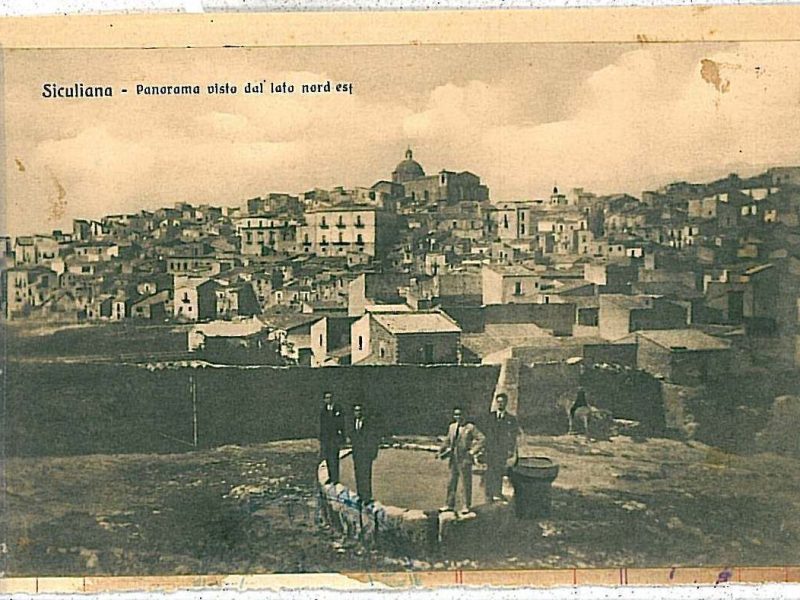
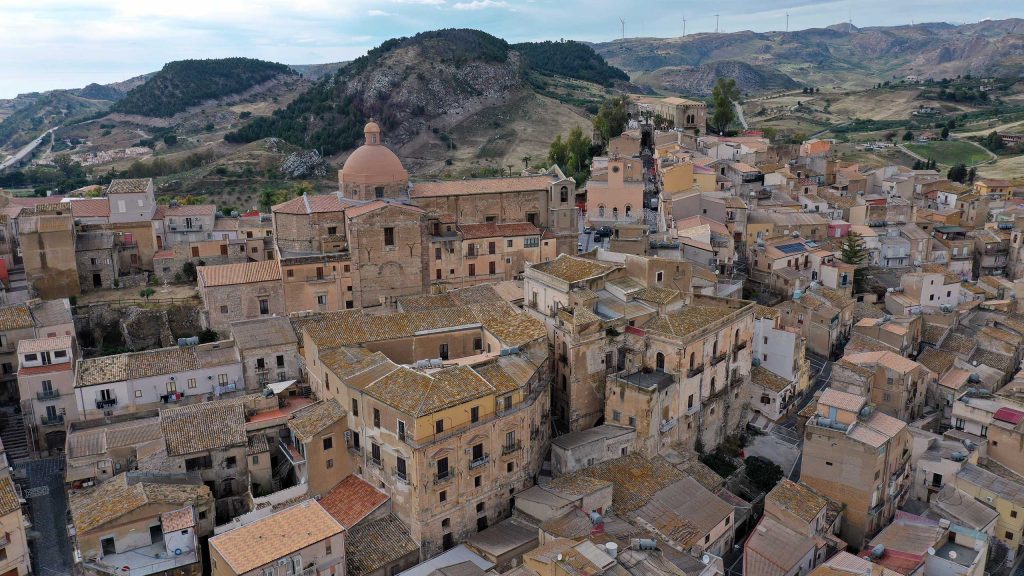
The ancient town of Siculiana sits on a ridge above the southern coast of Sicily, high enough that on a clear morning a man standing in Piazza Umberto I can see the Mediterranean glittering three hundred feet below. The 17th-century dome of the Sanctuary of the Holy Crucifix and the remains of the 14th century Chiaramonte Castle preside over the town's tight streets, streets that bend and narrow in ways that betray their Arab origins, opening suddenly into small courtyards where the light falls almost straight down at noon and where the heat collects in the stone. In the hills behind the town, almond trees bloom white in February. In summer, the same hills bake colorless and dry. It is a beautiful place in the way that many places built for endurance are beautiful: not designed to impress, but shaped over centuries into something that exactly fits the life it contains. Vincenzo Lanovara knew every corner of it by the time he was twenty. By the time he was thirty, he understood that knowing it was not enough.
Vincenzo was born in 1873, the son of laborers in a village whose two economic pillars, sulfur mining and agriculture, were both failing. At the turn of the twentieth century, Siculiana's beauty masked an economy in the final stages of collapse. The region around Agrigento had once supplied the world with sulfur, providing the raw material for fertilizers, explosives, and pharmaceuticals which was extracted from the chalky plateau above by, at its peak, nearly 40,000 men and boys working in heat and darkness that shortened lives by decades. But American technology had made the Sicilian method obsolete, and the mines were closing.
With the decline in sulfur mining, the agricultural backbone of the region, the very soil that had sustained families for generations, was shattered by a series of biological and political disasters.
Above ground, the vineyards that had supplemented the sulfur income were dying too, eaten by the Phylloxera blight that had worked its way south from the French wine country. For farmers like Vincenzo, this meant the sudden disappearance of seasonal work and the death of the small family plots that had provided a vital supplement to their subsistence.
Once called the granary of Rome, the Sicilian grain market that remained was throttled by overproduction and the weight of state taxes that made bread more expensive than the wage that bought it. This economic disaster was finalized by a disastrous tariff war with France in 1888, effectively closing off Italy's most important export market. The loss of French trade cost the Italian economy billions of lire and robbed Sicilian farmers of their primary outlet for wine and fruit. For Vincenzo, the calculation was simple and brutal: a man could work the failing land his entire life and end it poorer than his father.
These compounding failures turned the Sicilian countryside into a land of widespread poverty and social unrest that sparked the rise of the Fasci Siciliani labor movements. However, these attempts to secure fair wages and safety were met with government suppression and violent military intervention, leaving the workforce disillusioned and desperate for an escape from systemic poverty.
As the traditional structures of Sicilian life disintegrated, a new and predatory power rose to fill the vacuum: the Mafia. Emerging in the mid-19th century during the chaotic transition to Italian unification (Risorgimento), the Mafia thrived where the distant Roman government failed.
While Sicilians had been amongst the first to fight for and believe in the Risorgimento, their hopes were short-lived. Beyond the heavy taxation, the new government imposed a mandatory seven years of military service. Conscription particularly hit agricultural areas like the countryside around Agrigento, where young men provided an invaluable contribution to the subsistence farming activities of their families. The dismantling of feudalism did not bring freedom for the peasantry; instead, it created a lucrative opening for the gabelloti — ambitious estate managers who acted as intermediaries between landless laborers and absentee landlords. These "men of honor" exploited the weak state presence to enforce a private system of "protection," turning themselves into the region's true masters through a combination of local prestige and cold-blooded extortion.
In the Agrigento region during the 1870s and 1880s, these structures took the form of the Fratellanza, or "Brotherhood." This organized network was deeply embedded in both the sulfur mines and the agricultural estates, where they forced landowners and workers alike into a system of payoffs to avoid the destruction of their property or crops. By the time Vincenzo was considering his future, the Fratellanza had already established the code of omertà: a wall of silence that ensured justice was never sought through the law, but only through the "honorable" (and often violent) mediation of the Brotherhood.
For farmers like Vincenzo, the decision to leave Siculiana was not just an escape from poverty or the failing mines; it was an escape from a society where the rule of law had been replaced by a cycle of exploitation.
Vincenzo, however, was no longer alone. He had married the daughter of a Siculiana family — the Vellas — with special dispensation from the Bishop of the Agrigento Diocese.
The Bishop's dispensation was not an unusual accommodation for a village of Siculiana's size. In a town of six thousand souls, the same surnames recur in every generation of the parish registers — Vella, La Novara, Indelicato, Cibella, Gentile, Siracusa, Vasile, Valenti, Tabone, Tamburello, Graceffo — rotating through one another in an endless exchange of marriages, godparenthoods, and shared witnesses at births and deaths. To marry someone entirely unrelated to you in Siculiana would have been the rarer event. This web of obligation and kinship was not merely social custom; it was the architecture of survival in a place where the state had failed, the landowners had extracted blood and sweat, and family remained the only institution that held true. It was an architecture that proved portable. The same cluster of surnames that fills the Siculiana registers of 1897 reappears, decades later, in the city directories of Auburn, New York. The same clans reconstituted on the banks of the Owasco River.
Bringing home very little pay for typically backbreaking work in the fields, he and Onofria struggled to make ends meet. Like many other Agrigento families, they also faced their share of early tragedy. Their first-born son Joseph, born in 1898, the year after their marriage, died in infancy. Following Sicilian tradition, when they welcomed a second son into their household in 1901, Vincenzo and Onofria named him Giuseppe, after his deceased brother. A year later, their daughter Maria was born. The struggle to survive in Siculiana became increasingly difficult as their family grew. Increasing taxation and rising costs would have left them wondering about the potential of a new start elsewhere.
During this time, emigration from Sicily had exploded. In the first 15 years of the twentieth century, more than one million Sicilians emigrated, with about 90% choosing the United States as their preferred destination. In 1906 alone, some 100,000 Sicilians emigrated to the United States.
Many Sicilians, particularly those who arrived in the United States in the first 15 years of the twentieth century, had no intention of staying permanently. Indeed, significant numbers — some estimate up to 50% — returned home as soon as they had made enough money to buy some land, build a house, and provide for their family. When these so-called birds of passage did eventually arrive back in Sicily, their relative riches inspired others to chase the American dream.
The emigration from Siculiana followed a pattern of chain migration, where one "pioneer" would settle in a foreign city and then send for brothers, cousins, and neighbors. Significant Siculianesi communities formed in Brazil and Argentina specifically because of subsidized travel and agricultural opportunities. Other Siculiana natives emigrated to Canada for mining and construction work, largely clustered around Montreal and Toronto. Most, however, emigrated to the northeastern United States, and so it was for Vincenzo — his cousin Paolo Indelicato had traveled to Buffalo, where he joined the Italian-American colony centered on Canal Street. And in the same year Vincenzo eventually boarded his ship for New York, his first cousin Nicola Gentile, just seventeen years old, from the same ridge town, carrying the same village in his head, also sailed for America. They would build very different lives with what they brought.
For Vincenzo, the decision to leave Siculiana in early 1903 was a heavy, calculated sacrifice. He was not traveling as a single man, but as a father and husband who had to make the agonizing choice to leave his wife, Onofria, and their young children behind. This was a common "pioneer" strategy: the head of the household would face the hazards of the New World alone, aiming to secure a foothold before the rest of the family followed. The departure from his home village was a final, often permanent, goodbye; to reach the port of Naples, Vincenzo had to travel hundreds of kilometers across a fractured Italian landscape — a "first migration" that was a hardship in its own right.
Upon arriving in Naples, the romantic image of a Mediterranean port vanished. Vincenzo found himself in a chaotic, crowded urban center, waiting for days in cheap, cramped lodgings. The port was a place of high anxiety, filled with medical inspections and endless paperwork, where a single clerical error or a lingering cough could derail the entire journey. On March 15, 1903, he finally boarded the SS Neustria, a vessel owned by the French Fabre Line. Like many Italians of the era, Vincenzo traveled on a foreign-flagged ship because they offered more frequent departures than the developing Italian merchant marine, even if it meant being packed into an iron-hulled steamer built two decades earlier.
Built in 1883 by Claparede & Cie in Rouen, France, Neustria was approximately 344 feet long, with a beam of 42 feet. She had a compound engine and single screw, one funnel, two masts, and a straight stem, and was of iron construction. She could carry 8 first-class passengers and 1,000 passengers in steerage. She primarily served routes between Marseilles, Naples, and New York as a significant immigrant vessel during the late 19th century, frequently transporting hundreds of passengers, including Italian immigrants.
The passage across the Atlantic took over two weeks, and for a third-class passenger like Vincenzo, life was lived in the "steerage": the dark, cramped belly of the ship. This was a world of iron bunks, low ceilings, and poor ventilation. When the weather turned rough, the air below deck became heavy with the smell of damp clothes and the inescapable stench of seasickness. Hygiene was a constant struggle, and the food was a monotonous rotation of hard bread and basic pasta. Yet, in this "forced community," a sense of shared destiny emerged. Between the bouts of storms and the fear of the vast, indifferent ocean, passengers sang songs and shared what little they had, gambling their entire lives on the hope that the Promised Land was real.
That fear was real, and many ships did not make it to the New World. Sometimes the ocean, symbol of the hope for a new life, turned into a grave. There were disasters that became nightmares in Italian newspapers: ships overloaded, accidents, storms, bad decisions near the coast. One of the most infamous was the Sirio. In 1906, this Italian steamship carrying many migrants bound for South America, struck a reef near the Spanish coast. Panic spread. Lifeboats were few and confusion was everywhere. Local fishermen and nearby vessels pulled survivors from the water, but hundreds died.
The Neustria, in fact, had a fate of her own. On October 27, 1908, she sailed from New York for Marseille with grain and general cargo, and vanished without a trace. She was not carrying any passengers at the time, but her entire crew of 40 was lost. Her wreck has never been found and her fate remains a mystery. The French Naval Department dispatched the cruiser Admiral Aube to search for her between Bermuda and Madeira. That search was in vain.
The end of Vincenzo's voyage was marked by the silhouette of the New York skyline on April 2, 1903. But the true hurdle remained: Ellis Island. For Vincenzo, the arrival was a final interrogation. He was subjected to rapid-fire medical exams and legal questioning, where the threat of being "rejected" loomed over every interaction. He could not read or write. He listed Paolo as his contact in Buffalo. With only about $20 to his name and the weight of a family waiting back in Siculiana, the stakes could not have been higher. Only after passing these final checks could he finally step onto American soil.
For Paolo, arriving in Buffalo meant stepping into the "Canal District," a sensory-overload of a neighborhood that was rapidly transitioning from a notorious den of vice into a dense, striving Sicilian enclave. Settling on Canal Street (renamed Dante Place in 1909 to signal its new Italian identity), Paolo would have found himself in a world known as "The Hooks," named for the cargo hooks used by the longshoremen and dockworkers. While the district’s early reputation was defined by saloons and brothels, by the time Paolo arrived, it was a hub of "men of honor" and laborers from the Agrigento region, all seeking to escape the crushing taxes and famine of the homeland. Life was lived in the shadow of the massive Buffalo lake boats, where Italian fruit vendors at "the Coop" and bilingual signs at the local bathhouses created a familiar, if crowded, sanctuary. Paolo’s reality was one of extreme physical hardship and architectural decay. He likely lived in a former hotel-turned-tenement, such as the infamous Revere Block, where over a thousand residents were crammed into spaces originally designed for a hundred.
It's not clear if Vincenzo ever made it to Buffalo. While he listed his cousin Paolo as his contact in the US, there's no definitive record of Vincenzo being there.
It's also not clear that Vincenzo's goal was to stay in the US — he had a wife and family back home in Siculiana. But in 1904, while Vincenzo was navigating life in the United States, the family he was working to save was being dismantled by the very environment he had fled. 1904 became a year of unbearable silence for Onofria in Siculiana, as the "invisible threats" of the region finally breached their home. At the time, the Agrigento province was a landscape defined by endemic malaria and respiratory plagues. These diseases preyed on a population already weakened by the grain crisis and the heavy labor of the mines, turning even minor ailments into life-and-death struggles for the village's children.
At 7:20 in the morning on April 10th, as the spring rains turned to a damp, heavy heat, three-year-old Giuseppe, with an immune system likely weakened by the malaria that often haunted the crowded stone houses of Via Pirroli, succumbed, perhaps to lingering winter pneumonia or something worse. Vincenzo's mother, Maria Gentile, at sixty-six years old, walked the few hundred steps from the house to the Comune di Siculiana with her elderly neighbor Pietro Zirrelli to record the death. Unable to read or write, she left her mark on the certificate. His death left Onofria to face her mourning with her husband an ocean away and unable to be reached except by slow, agonizing letters.
The tragedy was compounded just four months later. In the sweltering, airless heat of summer, two-year-old Maria died on Via S. Antonio at 8:20 in the morning of August 12th. Infant deaths in Sicily in August often bore the hallmarks of the "summer scourge": the rapid, dehydrating gastric infections that flourished in the Sicilian heat when water sources became stagnant and food spoiled in the sun. This time, less than an hour after Maria's passing, Onofria's sister Antonina made the slow walk to the town hall, again with Pietro Zirrelli. In four months, two different women from two different sides of the family came to the same town hall with the same old neighbor to register two dead children. The grandmother in April. The sister in August. Both illiterate. Both unable to sign their names. For Onofria, the Promised Land must have felt like a cruel mirage; by the time she finally joined Vincenzo in 1905, she was no longer bringing a young family to a new world, but escaping a graveyard of her own children.
The arrival of the SS Gerty in New York Harbor on July 5, 1905, marked the closing of a tragic chapter and the beginning of an American one. For Onofria, the sight of the Statue of Liberty was not just a symbol of opportunity, but a signal of safety. Having survived the biological and economic collapse of Siculiana, and having buried three children before her thirtieth birthday, she arrived at Ellis Island with a rare set of tools for a woman of her time: the ability to read and write, and the grit to have funded her own escape.
When she finally reunited with Vincenzo, they were a family of two, stripped of their past but possessed of a hard-won resilience. The Gerty, a modern steel-hulled steamer, had carried her away from a world of feudal ghosts and predatory "Brotherhoods" and into a future where, for the first time in years, the threat of the "empty cradle" was replaced by the necessity of building something permanent. Their story was no longer about the Sicily they lost, but about the life they would now forge together in the New World.
End of Chapter One